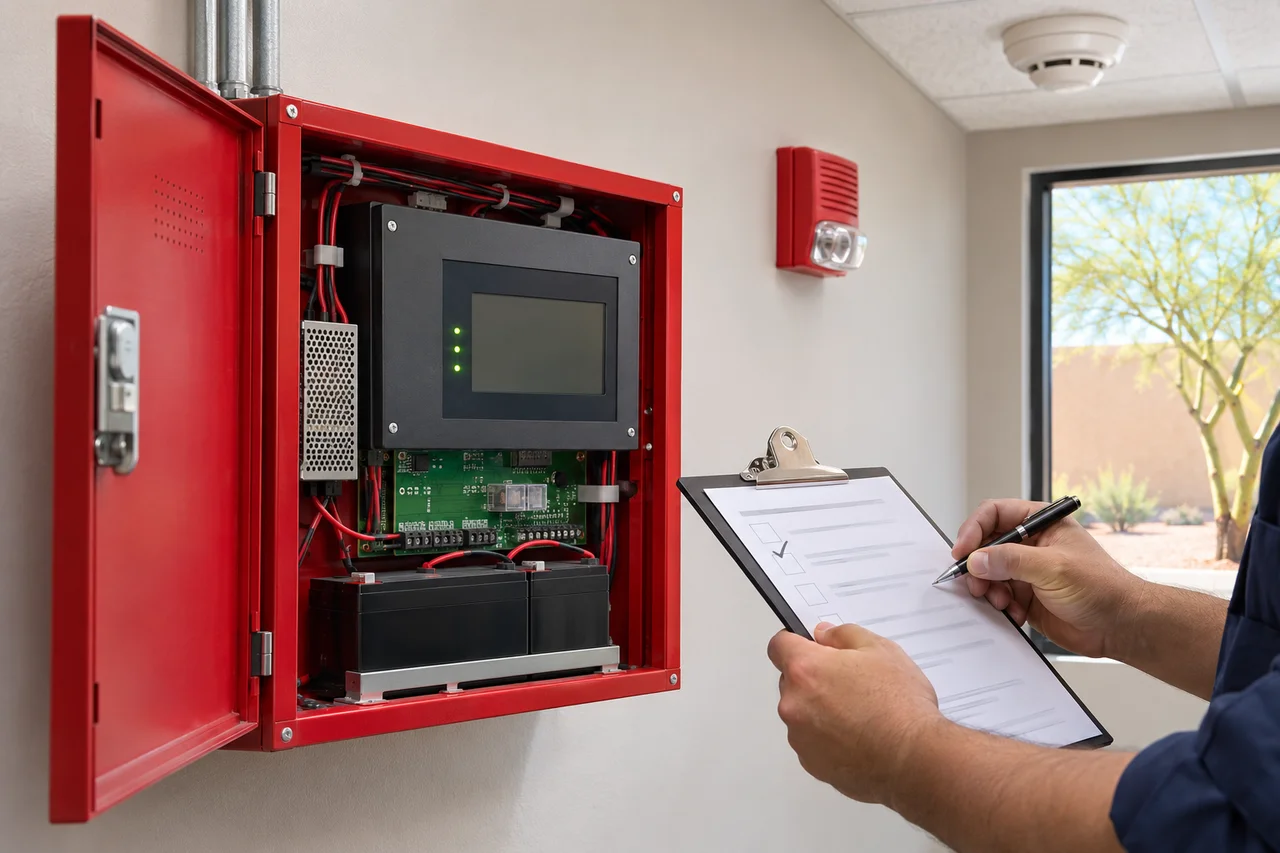
Fire Alarm Inspection Checklist: What Gets Tested and How Often
A fire alarm inspection checklist covers the control panel, backup batteries, smoke and heat detectors, pull stations, horns and strobes, and the connection to the monitoring center. NFPA 72 requires a full inspection and test by a qualified technician at least once a year, with some parts checked every six months or more often.
That is the short version. The longer version matters if you manage a building in Tucson, because the fire marshal will ask for the report, your insurer may ask for it after a claim, and the checks that get skipped are usually the ones that fail when there is a real fire. Below is the checklist we work from, the schedule behind it, and the problems we find most often in Southern Arizona buildings.
What are the fire alarm inspection requirements in Arizona?
Arizona businesses follow the fire code adopted by their city or fire district, and those codes point to NFPA 72 for inspection, testing and maintenance. Tucson, Phoenix and most Arizona jurisdictions adopt the International Fire Code, whose fire alarm section sends you straight to NFPA 72 for the schedule.
NFPA 72 is the National Fire Alarm and Signaling Code published by the National Fire Protection Association. The National Fire Protection Association describes NFPA 72 as the code that covers the application, installation, location, performance, inspection, testing and maintenance of fire alarm systems. In plain terms, it is the rulebook your inspector follows.
Two more layers sit on top of it:
- The authority having jurisdiction (AHJ). In Tucson that is the Tucson Fire Department’s fire prevention staff. Outside city limits it is usually the local fire district. The AHJ can ask for more frequent testing than NFPA 72 does.
- Your insurer. Many commercial policies require proof of annual fire alarm inspections. After a fire or water claim, a missing report can slow things down or reduce what gets paid.
Fire alarm inspection requirements also depend on the building. A restaurant, a school, a warehouse and a three-story office each have different devices, so the checklist below is a starting point that your inspector adjusts to what is actually on the walls and ceilings.
How often should fire alarms be inspected?
At minimum, once a year by a qualified technician, plus visual checks every six months. Some parts, like smoke detector sensitivity, run on a two-year cycle. The schedule depends on the component, and the table below shows the most common intervals for a monitored commercial system.
| Component | Visual inspection | Functional test | What can go wrong |
|---|---|---|---|
| Fire alarm control panel | Annually (weekly if the system is not monitored) | Annually | Trouble lights ignored for months, outdated software, failed circuits |
| Backup batteries | Semiannually | Annually (load and charger test) | Batteries past their date code, swollen or leaking cases |
| Smoke detectors | Semiannually | Annually; sensitivity every two years | Dust, paint over the head, wrong location |
| Heat detectors | Semiannually | Annually | Damaged or painted elements, wrong temperature rating |
| Manual pull stations | Semiannually | Annually | Blocked by furniture or displays, broken covers |
| Horns, strobes and speakers | Semiannually | Annually | Too quiet for the room, strobe out of sync, missing in restrooms |
| Duct detectors | Semiannually | Annually | Dirty sampling tubes, fans not shutting down |
| Monitoring communicator | Annually | Annually | Old phone lines disconnected, signals never reaching the center |
These intervals are the common minimums from NFPA 72. Your AHJ, your insurer or the manufacturer’s instructions can shorten them, and the edition of the code your city adopted can change details. When in doubt, the stricter schedule wins.
What is the difference between an inspection and a test?
An inspection is a visual check. The technician looks at a device and confirms it is there, undamaged, unobstructed and in the right place. A test means operating the device: putting smoke into a detector, pulling a station, or cutting power to see whether the batteries take over. A checklist that only says “inspected” for a smoke detector has skipped half the job.
What is on a fire alarm inspection checklist?
A complete fire alarm inspection checklist walks through every part of the system in the order the signal travels: from the device that detects the fire, to the panel, to the people inside, to the monitoring center. Here is what ours covers.
1. Control panel and power
- Panel shows normal status with no trouble, supervisory or alarm conditions
- Primary power circuit is labeled, locked and on a dedicated breaker
- Panel date and time are correct, and event history is reviewed for recurring troubles
- Remote annunciators match the main panel
- Zone or device labels match the building as it exists today
2. Backup batteries
- Date code checked and recorded
- No corrosion, swelling or leaking
- Load test confirms the batteries can run the system for the required standby and alarm time
- Charger output tested
3. Initiating devices
- Every smoke detector, heat detector and pull station visually checked and counted against the device list
- Each device activated and confirmed at the panel with the correct address or zone
- Smoke detector sensitivity measured on schedule
- Duct detectors tested, including fan shutdown
4. Notification appliances
- All horns, strobes and speakers activate
- Strobes flash in sync where several are visible at once
- Sound level is loud enough for the space, especially in mechanical rooms and kitchens
5. Building functions tied to the alarm
- Magnetic door holders release
- Elevators recall if the building has them
- HVAC units shut down when duct detectors trip
- Access-controlled doors release on alarm where the code requires it
6. Monitoring and reporting
- Alarm, trouble and supervisory signals received by the monitoring center and verified by phone
- Communicator path tested (cellular, internet or phone line)
- Deficiencies listed with a recommended fix
- Signed report delivered to the owner and, where required, to the fire department
If your building has an addressable fire alarm system, each device reports its own address, so the report can name the exact detector that failed. With a conventional fire alarm system, the panel only knows which zone tripped, which makes the device list and labeling even more important.
Who can perform a fire alarm inspection?
Building staff can handle the simple visual checks, but the annual inspection and testing must be done by a qualified fire alarm technician. NFPA 72 asks for people with documented training and experience. Many AHJs look for NICET certification or a manufacturer certification for the specific panel.
What your own team can do between visits is worth more than people think. Walk the building once a month. Look for trouble lights on the panel, pull stations blocked by new shelving, detectors covered during remodels, and ceiling tiles moved around detectors. Write down what you find. Those notes save time during the annual inspection and keep small problems from turning into failures.
What happens during a fire alarm inspection?
A typical inspection follows the same order every time:
- Notice. We call the monitoring center to put the account on test, and you tell staff and tenants that alarms will sound.
- Panel review. The technician checks the panel, power and batteries, and reads the event history.
- Device testing. One technician activates devices while another watches the panel, or the panel runs in walk-test mode.
- Building functions. Door holders, HVAC shutdown and elevator recall are confirmed.
- Monitoring check. Signals are sent and confirmed with the monitoring center.
- Restore and report. The system goes back to normal, the account comes off test, and you get a written report.
How long does a fire alarm inspection take?
A small retail space or office suite with a few dozen devices usually takes one to three hours. A school, hotel or warehouse with hundreds of devices can take a full day or several visits. Device count drives the time more than square footage does.
What are the most common fire alarm inspection failures in Tucson?
Most failures are not dramatic. They are small things nobody noticed until the inspector did. These are the ones we see most often in Southern Arizona buildings:
- Dead or expired batteries. Panels in hot electrical rooms and unconditioned attics wear out batteries faster. Batteries past their date code are the most common line on our deficiency reports.
- Dust in smoke detectors. Monsoon storms and dust from desert lots work their way into detectors, which then fail sensitivity tests or start causing false alarms.
- Remodels that skipped the fire alarm. New walls, offices or drop ceilings that cut a room off from its strobe or detector.
- Blocked pull stations. Displays, carts and furniture parked in front of them.
- Dead phone lines. Systems still dialing out over copper lines that the phone company has disconnected, so the monitoring center never hears the alarm. This is why we move older panels to 24/7 fire alarm monitoring over cellular communicators.
- Labels that no longer match the building. “Zone 4: Suite 120” means nothing when Suite 120 became two offices three tenants ago.
When a device fails, the inspector notes it, and you are expected to fix it promptly. Most failures are simple fire alarm repair jobs. A panel that is no longer supported by its manufacturer is a bigger decision, and our guide on when to replace a fire alarm system explains how to tell when a repair stops making sense.
How much does a fire alarm inspection cost?
Fire alarm inspection cost depends on how many devices the building has, how many building functions are tied to the alarm, and how easy the devices are to reach. A small office with a couple dozen devices costs far less than a hotel with hundreds of detectors and elevator recall. High ceilings that need a lift add time.
The cheaper choice over a few years is almost always a scheduled annual contract rather than a one-off visit right before the fire marshal arrives. A contract keeps the semiannual checks on the calendar, and problems get caught on a normal service day instead of during a failed inspection. For a price on your building, Connect Security offers fire alarm inspection services with a free estimate.
How do you prepare for a fire alarm inspection?
A little preparation makes the visit shorter and keeps it from disrupting your business:
- Find last year’s report and the list of deficiencies, and confirm they were fixed
- Pull the as-built drawings or device list if you have them
- Clear access to the panel, the riser room, pull stations and any locked rooms
- Tell employees and tenants the date and time so alarms don’t cause a panic
- Schedule around peak hours, or ask for an after-hours visit
- Note any recent remodels or new equipment the technician should know about
If you are planning a remodel or adding devices, it often makes sense to line up fire alarm installation work with your annual inspection so the system is tested once, in its final layout.
Frequently Asked Questions
Is a monthly fire alarm inspection checklist required?
Not by NFPA 72 for most monitored commercial systems, but a short monthly walk-through by your staff is a good habit. Some AHJs and insurers ask for it, and it catches blocked devices and trouble lights early.
Do smoke detectors in businesses need to be replaced?
Yes. Smoke detectors wear out, and manufacturers generally call for replacement after about 10 years. Sensitivity testing every two years shows which ones are drifting before that. Heat detectors last longer but still need regular testing; see our page on heat detectors.
Who gets the fire alarm inspection report?
The building owner always gets a copy. Many fire departments also require the inspection company to submit it, and your insurer may ask for it at renewal. Keep at least the last few years of reports on file.
What happens if my building fails a fire alarm inspection?
You get a list of deficiencies and a deadline to correct them. Serious problems, like a system that cannot report to the monitoring center, may require a fire watch until the system is repaired. Most failures are fixed in a single follow-up visit.
Can Connect Security inspect a system someone else installed?
Yes. We inspect, test and repair fire alarm systems from most major panel manufacturers, regardless of who installed them. Contact us for a free estimate on your building in Tucson, Phoenix or anywhere in Southern Arizona.
Need help with a different part of your system? Read our guide to fire and smoke detection, or call Connect Security at (520) 790-7302.